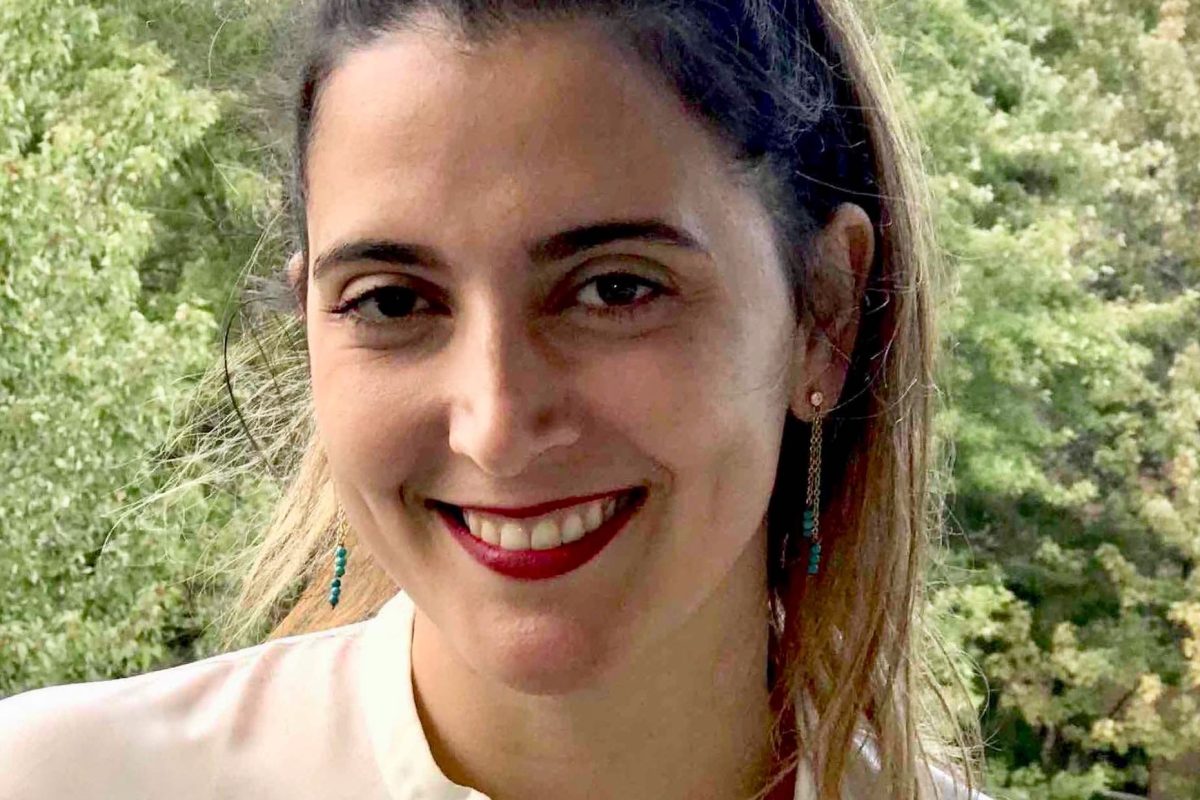
How does the human brain work to make meaning? Can researchers develop an AI model that captures this process? These are the big questions of Leila Wehbe’s research.
This summer the Department of Biomedical Data Science welcomed Leila Wehbe, associate professor of biomedical data science and of neurology and neurological sciences, to Stanford University. Previously, Wehbe was an associate professor in the Machine Learning Department and the Neuroscience Institute at Carnegie Mellon University. In her research, she combines cognitive neuroscience and artificial intelligence to advance understanding of the human brain and to improve AI systems’ modeling of the brain.
As Wehbe begins her tenure at Stanford, she discusses her approach to bridging cognitive neuroscience and AI, with the goals of demonstrating how the brain makes meaning as well as improving individualized patient care and speech-producing AI tools for patients with neurological conditions. She looks forward to opportunities to collaborate with Stanford colleagues in data science, neurology, AI, computer science, psychology, language processing and medicine.
Your training spans machine learning, electrical and computer engineering, biology and biomedical engineering. What drew you to neuroscience and biomedical research?
I’ve always been interested in intelligence, both in artificial systems and in nature. I’m interested in how humans grow, think and carry out the computations our brains are capable of, but also in what happens when something goes wrong. How can we help the brain recover from disease and other conditions?
Your research bridges machine learning and cognitive neuroscience to study how meaning is represented in the brain. Please elaborate on the focus of your work.
Machine learning is fascinating on its own, but its intersection with cognitive science and cognitive neuroscience is even more interesting. As AI has become pervasive, people increasingly compare themselves with machines. In my work, we ask how do people represent the world? How do they make meaning from what they perceive? How do those perceptions lead to action? How is this process similar to the way machines operate.
The goal is to use powerful computational tools to understand how we move from perception to action. From a medical perspective, we can ask what happens when that process is disrupted by stroke, epilepsy or other conditions. A better understanding of the brain could also improve neurotechnologies, including brain-computer interfaces that help people with paralysis to communicate. How can we adapt these tools to an individual person in a way that helps them speak more easily?
I’m interested in understanding how the brain represents information in more realistic settings. In everyday life, we interact with people, see and hear things, and use language at the same time. What happens when these different modalities interact? How does the brain flexibly combine information from all these sources? We need a dynamic understanding of the brain rather than a static one. How do the many tasks the brain must attend to affect what it represents and what it focuses on?
Machine learning gives us tools for building computational models to address these questions. One idea that has become widespread across disciplines is the foundation model. AI models became powerful because they were trained on vast amounts of data rather than narrowly tuned for one specific task. The question in neuroscience is, what happens if we train a computational model on large amounts of brain data from many people and across many tasks? Could we develop a model that generalizes and captures how brains work?
A brain foundation model could provide a strong prior based on what we have learned from many people’s brains. How can we use this extensive brain data to understand the condition of an individual patient and offer them individualized care? This could be especially useful for patients who may not be able to spend much time in an imaging scanner or complete many experimental tasks.
What questions have remained central throughout your work, and what findings stand out to you?
A central question concerns representation: how information is organized and used across different brain regions, how that organization supports a task and how it changes depending on what is happening at a particular moment.
One recent area of work examines multimodal meaning. When you watch a movie, you are processing both audio and visual information. Sometimes audio and visual streams in the brain are aligned. Something happens on screen, and the dialogue is about that event. Other times, the streams aren’t aligned. You might watch a show where people are sitting in a coffee shop discussing something unrelated to what is visually present. In some moments, visual information is crucial; in others, the audio is more important.
We are finding that certain brain regions combine information across these streams, while others appear to shift their attention toward the most relevant stream at a given moment. Some parts of the brain’s meaning system seem to focus on what matters most right now, whether the meaning comes through language, visual information or both.
In real life, we are not just visual- or auditory- or language-based beings. We are constantly integrating all of these sources of information. On a more philosophical level, this work may bring us a little closer to understanding the broader process and meaning of thought.
What are the potential clinical implications of this research?
The broader field of brain decoding and machine learning has helped enable technologies such as speech neuroprostheses. Researchers, including at Stanford, have developed devices for people who can no longer move or speak because of neurological injury or disease. Using electrodes in specific parts of the brain, these systems can decode what a person intends to say and produce speech for them. This can be more efficient than methods that require someone to select letters one at a time on a screen.
I am excited about the potential to make these devices more personalized and context-aware. Current systems often focus on signals from the motor cortex and ask a direct question: what sound does a person intend to make? But communication also depends on context. Our work on how the brain focuses on the most relevant information in a situation could eventually contribute to systems that incorporate more of that context.
Another possible application is in recovery from strokes and other conditions that alter brain function. In the future, we could map where and how information is represented in a person’s brain, then potentially identify how those representations differ after injury or disease. The hope is that this could help guide more individualized interventions.