| Dr. Roxana Daneshjou, Laura Adams, and Vardit Ravitsky, all experts at the intersection of healthcare, ethics, and technology, join host Peter Lee to discuss the responsible implementation of AI in healthcare. Daneshjou, a Stanford physician-scientist bridging dermatology, biomedical data science, and AI, discusses her work on identifying, understanding, and mitigating bias in AI systems and also leveraging AI to better serve patient needs.
Listen here: https://www.microsoft.com/en-us/research/podcast/laws-norms-and-ethics-for-ai-in-health/ |
The DBDS Education Committee undertook a “Curriculum Review Project” that culminated in a published review about graduate curriculum in Biomedical Data Science. Read it ahead of print here: https://www.annualreviews.org/content/journals/10.1146/annurev-biodatasci-090624-022951. The full publication will be available in August. Authors: Christine Y. Yeh, Dennis P. Wall, Karen Matthys, Chiara Sabatti, and Julia A. Palacios.
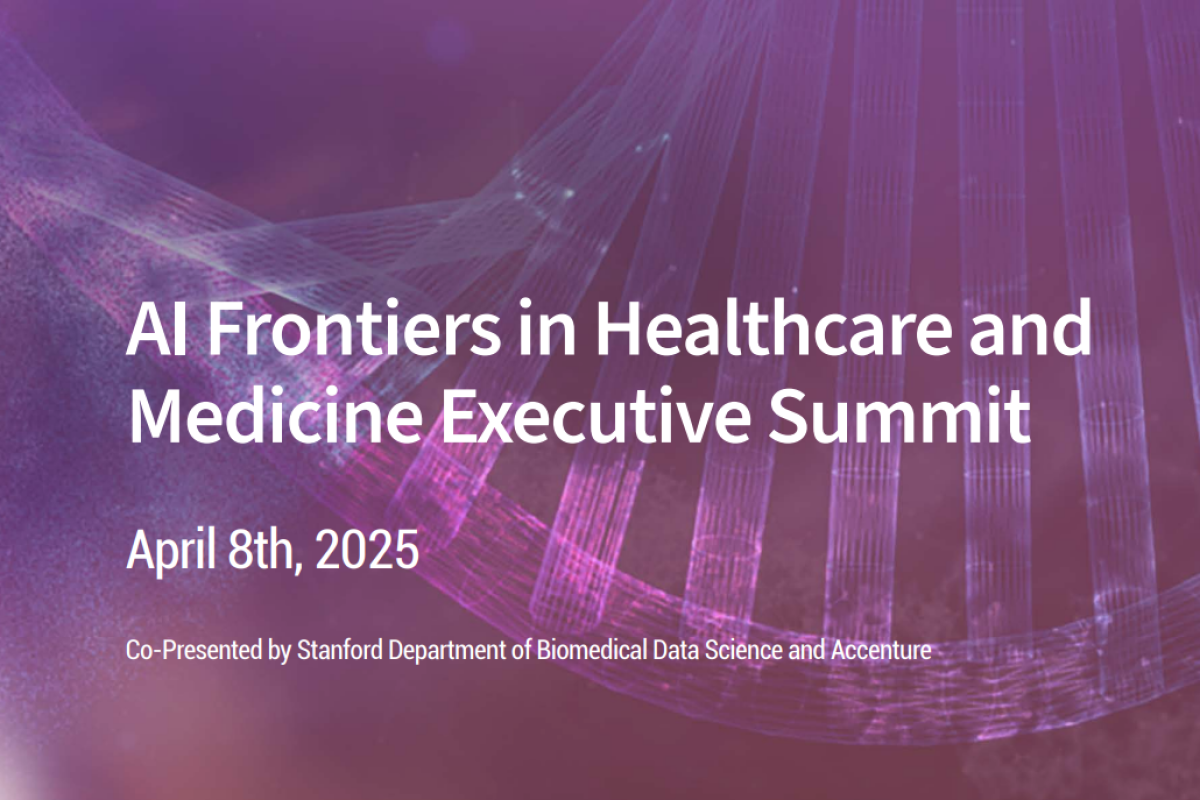
AI Frontiers of Healthcare and Medicine Summit delivers exciting opportunity for collaboration between industry, biopharma, and DBDS
In an rousing event that connected industry leaders from biopharma, consulting, tech, and start-up companies with Stanford faculty, postdocs, and students from the Department of Biomedical Data Science (DBDS), the future for research in the AI sphere felt limitless.
Read more here: https://dbds.stanford.edu/ai-frontiers-of-healthcare-and-medicine-summit/
More than three-quarters of the AI software cleared by the Food and Drug Administration for medical use is designed to support radiology practice, says Curtis Langlotz, a radiology professor at Stanford University and president of the Radiological Society of North America’s board of directors.
“AI is not a better kind of intelligence, it’s a different kind of intelligence,” Langlotz says. “A human plus a machine is better than either one alone. I would say that has been true since I began studying AI in the 1980’s, and it continues to be true today.”
Read more here: https://wapo.st/4jk7cmB