
DBDS Student Talks (BIOMEDIN 201)
Upcoming 10/7 Monday Talk Speakers:
|
Zoom Link: https://stanford.zoom.us/j/97747187137?pwd=QJqAPX1yRpGOwTTGPsIIwEYp7W2Aaz.1&from=addon
Password: 180750

DBDS Student Talks (BIOMEDIN 201)
Upcoming 10/7 Monday Talk Speakers:
|
Zoom Link: https://stanford.zoom.us/j/97747187137?pwd=QJqAPX1yRpGOwTTGPsIIwEYp7W2Aaz.1&from=addon
Password: 180750

Professor Curt Langlotz has been appointed Senior Associate Vice Provost for Research at Stanford University, effective August 1, 2024. He will work in the office of the Vice Provost and Dean of Research, which is responsible for the support and success of research across Stanford University. His portfolio includes shared research platforms, including computing, AI, and data science. To make time for this new role, Curt will be stepping down from his hospital and clinical roles. He will remain a Senior Fellow at the Institute for Human-Centered AI, and will continue to lead his NIH-funded research lab, the Center for AI in Medicine and Imaging, and the Responsible AI for Safe and Equitable Health initiative.
Congratulations, Curt!

Erin Craig, 6th Year PhD Student
(12:15pm-12:45pm)
Title: MMIL: A novel algorithm for disease associated cell type discovery
Abstract: Single-cell datasets often lack individual cell labels, making it challenging to identify cells associated with disease. To address this, we introduce Mixture Modeling for Multiple Instance Learning (MMIL), an expectation maximization method that enables the training and calibration of cell-level classifiers using patient-level labels. Our approach can be used to train e.g. lasso logistic regression models, gradient boosted trees, and neural networks.
Matt Aguirre, 6th Year PhD Student
(12:45pm-1:15pm)
Title: How can gene expression heritability be so diffuse across the genome?
Abstract: A major surprise from human genetic studies of expression quantitative trait loci (eQTLs) has been that cis-acting eQTLs located near a given gene typically explain a small fraction of the genetic variance in its expression. Although the cis-fraction of expression heritability has been repeatedly estimated to have a genome-wide median of around 20%, it is unclear how this property arises. Crucially, distal trans-eQTLs tend to have small effects, and the sample sizes of gene expression studies and increased multiple testing burden of genome-wide analysis both place limits on statistical power. Yet this also begs a paradoxical question: how can small trans-acting effects distributed throughout the genome end up explaining so much heritability?
Zoom Link: https://stanford.zoom.us/j/97747187137?pwd=QJqAPX1yRpGOwTTGPsIIwEYp7W2Aaz.1&from=addon
Password: 180750
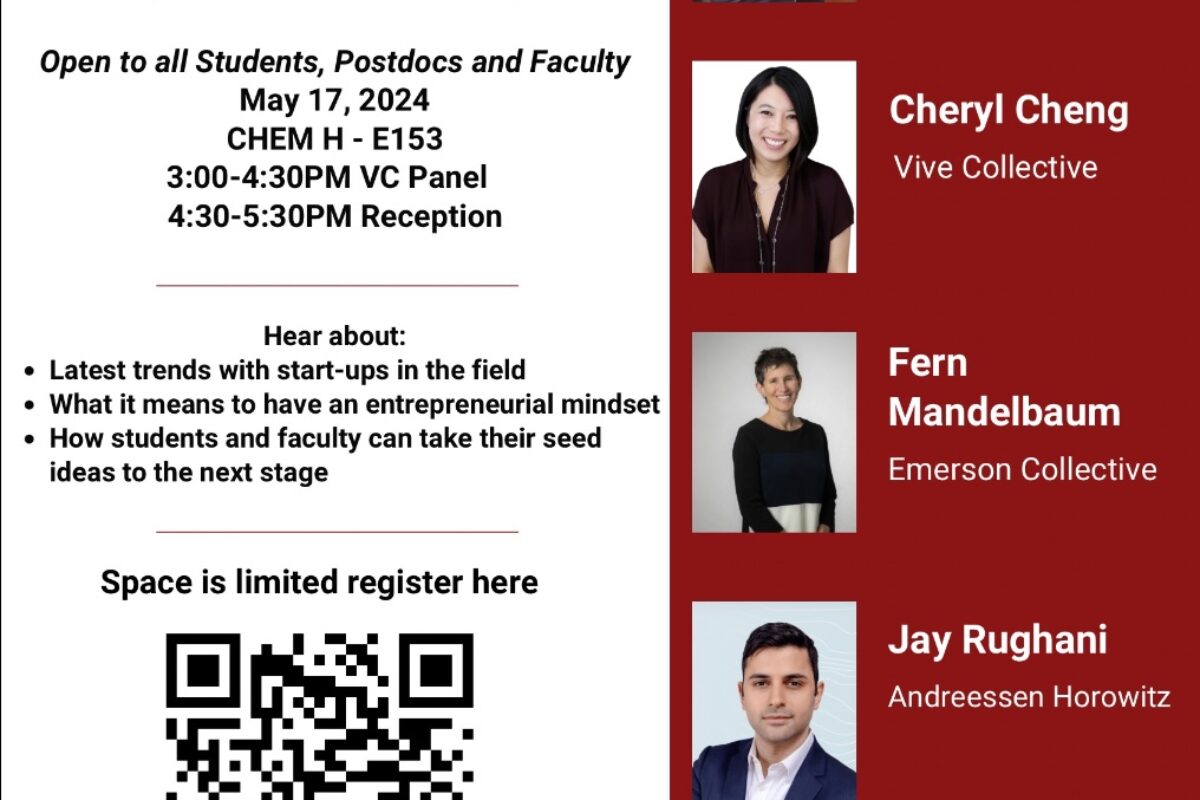
You’re invited to attend a VC panel on Generative AI and Healthcare on May 17th at 3:00PM. The panel will feature 5 Venture Capitalists and will focus on the latest trends, challenges and success factors with AI in healthcare startups. This panel is open to all faculty, graduate students and postdocs. It is sponsored by DBDS and the course BIODS 295 Generative AI in Healthcare.
When: May 17th, 3:00-4:30pm Panel; 4:30-5:30 Reception
Where: Chem H Building Room E153
Panelists: