Next Frontier in Medicine: AI That Learns, Adapts, and Helps Develop Medical Cures
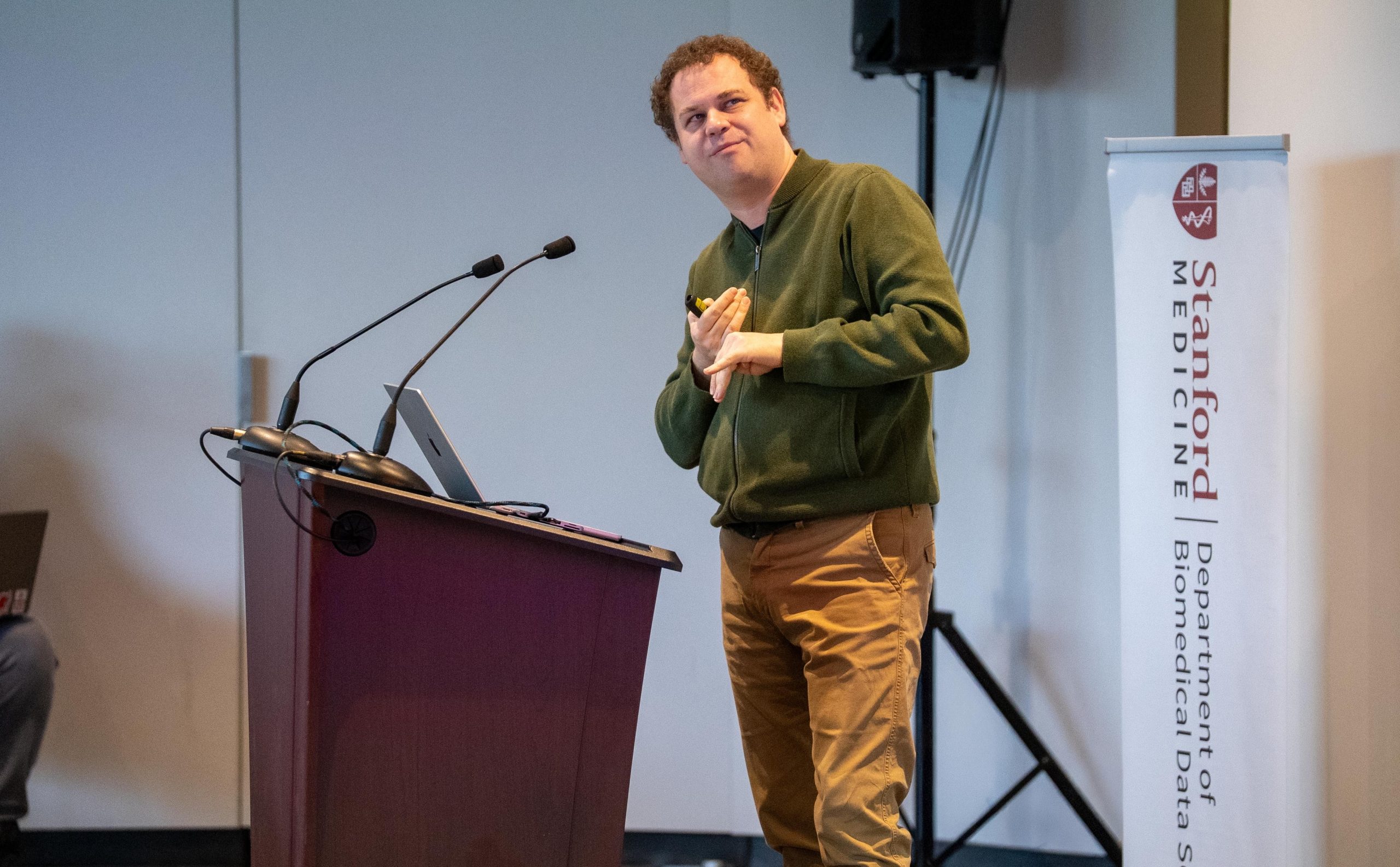
Computational scientist and keynote speaker John Marioni believes artificial intelligence (AI) has become so powerful it is now able to make real-world discoveries using publicly available medical and biological data—in turn helping develop new and better drugs faster than ever before.
Addressing the first annual Computational Biology and AI Research Symposium held by the Stanford Medicine Department of Biomedical Data Science, Marioni noted that targeting a specific molecule in a disease and developing a drug typically takes over eight years, with only a 1% success rate. However, the integration of AI presents exciting prospects for generative AI to accelerate this lengthy process and potentially double the success rate of bringing life-saving drugs to market.
“It’s the next technology that’s going to be transformative,” Marioni, senior vice president and global head of computational sciences at Genentech, said of generative AI. “So, it’s great that Stanford has this program here and we have the ability to talk about it today.”
Marioni delivered the keynote at the May 5 symposium, Stanford’s first event uniting faculty and students with complementary backgrounds crucial for interdisciplinary research. This collaboration is intended to drive significant advancements in drug development, leveraging the combined efforts of industry, academia, and government to tackle challenges and seize opportunities.
Advancing Precision Health
Syliva Plevritis, professor of biomedical data science and of radiology, and chair of the Department of Biomedical Data Science (DBDS), noted the inaugural symposium complements the department’s mission of advancing precision health by applying computational methods, including AI and machine learning, to complex biomedical data sets.
“Where are we going?” asked Plevritis. “I believe that we’re in an intertwined revolution of AI and biotech. And this revolution that we’re experiencing together is manifesting itself as a knowledge revolution—a knowledge revolution on the molecular basis of health and disease. And we’re realizing that now by leveraging multimodal data.”
Plevritis said patients generate an abundance of biological information through their electronic health records, pathology, radiology, and genomics.
“At large academic medical centers like Stanford, we have bio specimen cores where we can generate research data on patients that are seen in our hospital and clinics,” she said. “And that integration of the research, deep molecular research data with the real-world data on the continuum of care and outcomes for patients is where I think the most exciting interface is for AI to really help us understand the biology of disease.”
Plevritis noted that the department is now 10 years old and growing, due in part by donors like the Warren Alpert Foundation, which hosted the symposium and gave the department a $5 million grant to fund 15 graduate and postdoctoral scholars in computational biology and AI. The foundation devoted to improving the health of the public has partnered with the department to train future scientists and leaders who can bridge two worlds: understanding both the biology of diseases and the AI methodology to study and potentially treat and cure them.
Research Spotlights: Quick Hits and Deep Dives
The symposium included a round of lightning talks by postdoctoral researchers from DBDS and other Stanford departments, as well as longer research talks by faculty from Stanford, UCLA and UCSF.
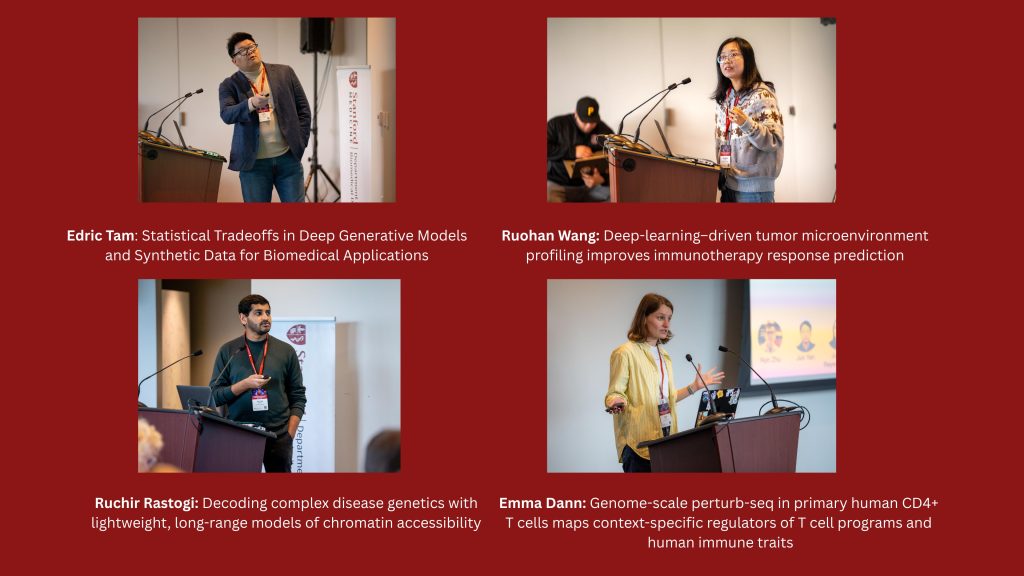
Edric Tam, the inaugural Warren Alpert Fellow in AI Computational Biology, gave a quick presentation on the statistical tradeoffs in deep generative models and synthetic data for biomedical applications. He highlighted two directions in his research. The first is when AI models try to learn from complex medical data, they always involve accuracy tradeoffs; he examines those tradeoffs and how to measure them. Tam then looks at what those tradeoffs mean in practice and whether we can trust the results.
The other DBDS postdoctoral scholars who presented were Ruchir Rastogi, Ruohan Wang, and Emma Dann.
In his research talk, Sohrob Shah, chief of computational oncology in the Department of Epidemiology and Biostatics at Memorial Sloan Kettering Cancer Center, highlighted the cancer center’s data science initiative, which has sequenced over 100,000 tumors and scanned 12 million pathology slides. He said a transformer model—a type of neural network that learns context and relationships using attention mechanisms—was fine-tuned to predict 124 cancer types. This is particularly important, Shah said, for the 5% of cancer patients whose tumors are undiagnosable, making it difficult for clinicians to treat.
“Scale is essential for granularity—and granularity is essential in diagnosis,” Shah said.
Olivier Gevaert, PhD, associate professor of medicine (computational medicine) at Stanford Medicine and of biomedical data science, runs a lab that focuses on multimodal data fusion, particularly in oncology and neuroscience, using various data types like images, text, and genomics data. Their goal is to combine digital pathology and genetic expression data to predict treatment responses in non-small cell lung cancer, which constitutes more than 80% of lung cancer cases and remains a leading cause of cancer-related mortality worldwide.
“We are very interested in mapping spatial omics to H&E images, because these are images that are routinely collected in clinic and they are the cornerstone of diagnosis in cancer patients. Fusion of different types of data likely will improve the performance,” Gevaert said. “And we have ongoing validation of these biomarkers in large, multimodal clinical trials of immunotherapy-treated patients in lung, breast and colorectal cancer.”
Industry Voices
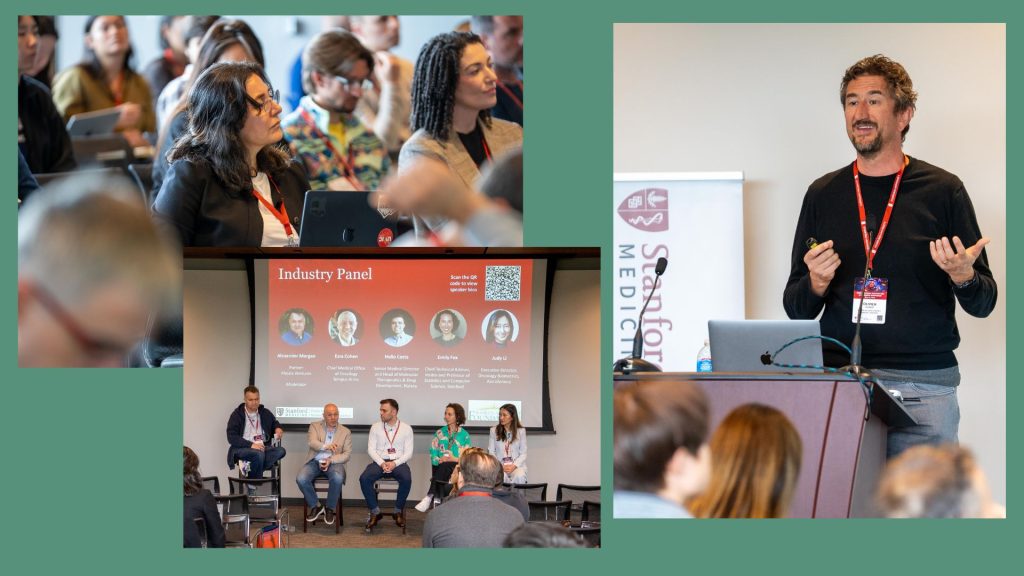
A highlight of the day was an industry panel of biotech experts who spoke frankly about the transformative impacts of AI on various aspects of health care and drug development. For example, Tempus AI Inc. uses LLMs to interrogate electronic medical records (EMRs) for decision support and drug development. AstraZeneca focuses on oncology strategy and biometrics, leveraging AI to accelerate innovation.
The panel said big challenges still include AI’s ability to predict patient responses and the need for better data annotation. They highlighted the need for rigorous validation and the potential for AI to enhance, not replace, human expertise—with one panelist emphasizing the importance of critical thinking, focus and the ability to connect concepts.
Ezra Cohen, MD, however, took a contrarian view. The chief medical officer of oncology at Tempus AI Inc., believes AI will one day take the lead in medical care, and “the human is no longer in the loop.” He said the technology is nearly there and that AI has already proven to be more empathetic than human doctors and responds more accurately than most.
“AI follows guidelines with fidelity, so it’s not that big of a leap to have the AI write the progress notes and the management plan, and then go into the EMR and execute that plan,” Cohen said. “That last step, the world is not ready for. But I think it will happen.”
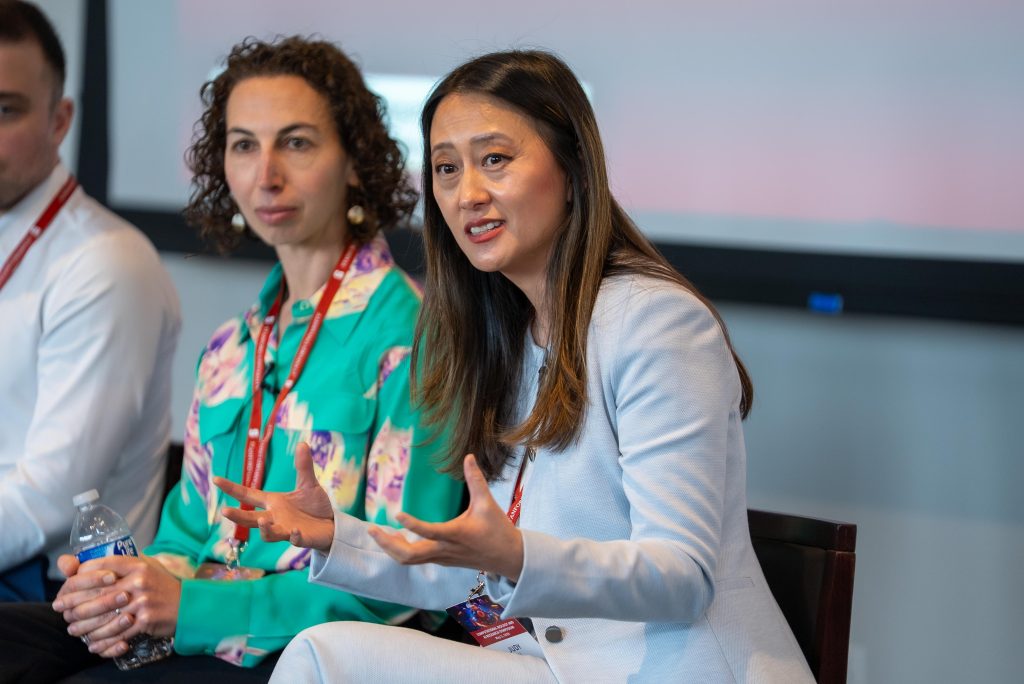 Alexander Morgan, a partner at Khosla Ventures and an alumnus of the PhD program in the Department of Biomedical Data Science, who moderated the industry panel, brought up that some biomedical data science trainees worry that AI will overtake their own talents and skills. He asked the panel of industry experts what they’re looking for in hiring.
Several panelists said they want recruits who can conduct rigorous validation of agentic systems and understand that AI is there to enhance, not replace, human expertise.
“Always be curious, always know what questions to ask,” said Judy Li, executive director of oncology biometrics at AstraZeneca. “The people who learn the most and grow the fastest are the people who ask the best questions.”
For Emily Fox, chief technical advisor at Insitro and professor of statistics and computer science at Stanford—it’s all about critical thinking and questioning AI results.
“For me, a focus is still on critical thinking skills,” Fox said. “You have to pick and pick and pick and be like, wait, that doesn’t make sense? You have to digest and analyze what these systems are producing and say, does that make sense biologically, does that make sense mathematically, statistically—and not just take the beautiful story.”
Student Voices
A closing poster session gave attendees a firsthand look at the work of trainees from Stanford, UCSF and the Gladstone Institutes are pursuing. Nineteen students—from biomedical data science to chemical engineering, genetics and cancer biology majors—presented poster abstracts on everything from characterizing pharmacogenetic variation among African ancestry participants in the NIH All of Us Research Program, to a Stanford pathology student examining whether mouse lymph node colonization models predict human tumor metastasis in melanoma.
Justin Adjasu, a DBDS Warren Alpert CBAI Scholar, presented: Deep Learning Analysis from Live-Cell Imagining of Cancer vs. TCR T Cell Interactions. The second-year master’s student showed how his research team is employing modern machine learning and AI tools to improve the analysis of how microorganisms behave together. They hope their approach will help fill the gaps in current methods and provide a clearer view of cell behavior.
Link to all the student poster abstracts
The inaugural Computational Biology and AI Research Symposium made clear that the convergence of AI and biotechnology is no longer a distant promise—it is already reshaping how scientists understand disease, develop drugs, and care for patients. From foundation models that can diagnose rare cancers to multimodal data fusion that predicts treatment responses, the work on display reflected both the remarkable progress and the enormous challenges ahead. Participant feedback was excellent overall and the department looks forward to the next CBAI conference next spring.

All photos by Ramin Karchagani