In 2026, AI is no longer adjacent to healthcare—it is integral to it. AI is creating new opportunities to interpret complex biomedical data and generate insights relevant to research and patient care. But the human-machine relationship continues to evolve at breakneck speed—with an urgent need for guidance and support from all sectors. That includes research institutions, healthcare systems, industry partners, government agencies, and nonprofit organizations.
Stanford’s Department of Biomedical Science (DBDS) is at the center of this transformation. DBDS convened these many voices at its fourth annual Collaboration & Careers Forum (C&C) held January 27, 2026, at Stanford’s Arrillaga Alumni Center.
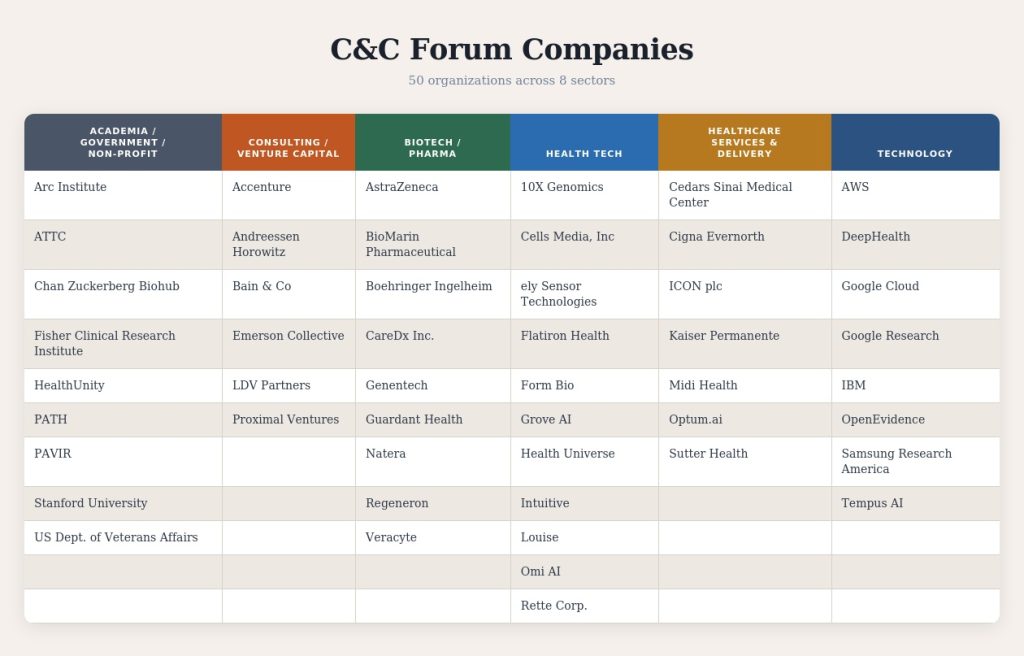
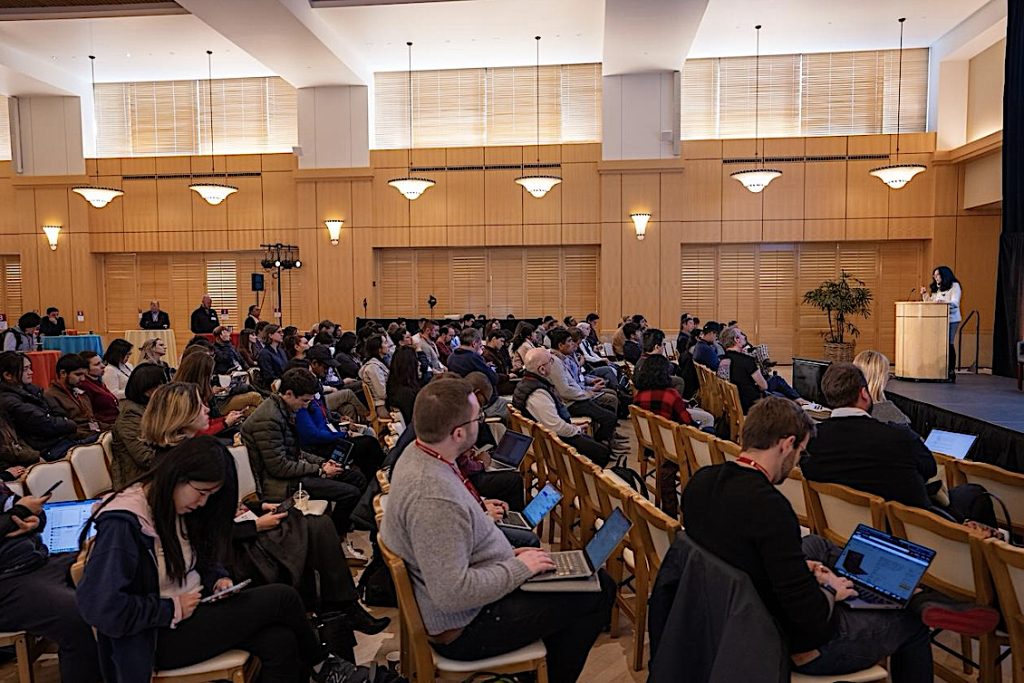
Enthusiasm showed up in the numbers: attendance rose more than 30 percent since last year, and company participation expanded from 40 to 52 organizations.
“Multisector involvement will address the many needs of the AI-driven healthcare revolution that is already underway,” said Karen Matthys, MBA, Executive Director of DBDS Graduate Program & Strategic Initiatives and the driving force behind C&C. “These alliances – within Stanford, across Silicon Valley, and globally—don’t necessarily happen on their own but are essential for successful development and responsible implementation of AI-driven healthcare.”
Research brings methodological rigor, novel scientific insights, and long-term vision. Industry brings scale, infrastructure, pathways to real-world deployment, and resources for developing and scaling state-of-the-art technologies. Government agencies and nonprofit organizations are critical to provide not just funding support, but also a rich variety of data sources, important insights on AI guardrails, and valuable complementary perspectives. The result is a virtuous cycle: accelerating discovery while ensuring AI tools are validated, safe, and clinically meaningful.
Making Multimodal Data Actionable through AI
Multimodal data integration is increasingly central to precision health – and it is a main driver of DBDS research. Rich datasets that contain electronic health records (EHRs), genomic information, radiology and pathology images, and data from wearable devices are being combined with advanced AI models to reveal patterns unseeable by humans, traditional microscopes, and even the most state-of-the-art imaging platforms.
In her talk, Professor and Chair Sylvia Plevritis, PhD, highlighted challenges with complex, large datasets such as pathology data. To counter these issues, her lab is developing spatial biology tools and pathology foundation models to view and analyze pathology data as unique cellular ecosystems.
Linking diverse health data streams through multimodal foundation models has the potential to unearth deep biological insights that could refine diagnoses, predict disease trajectories, and tailor precision therapies based on a person’s unique characteristics and health history—across the continuum of care.
“EHRs are actually multimodal data timelines,” said Assistant Professor Jason Fries, PhD. In his research talk, Fries described the challenge of constructing reliable longitudinal patient trajectories from noisy, biased, and incomplete clinical data – and the critical need for improved feedback loops to support effective human-AI teaming.
Data collected from wearables like smart watches and Oura rings can provide a wealth of information about women’s health. Professor Barbara Engelhardt, PhD, presented her current study, “Study on Typically Ignored Groups of Menstruating Adults (STIGMA),” which has collected wearable data for a year on 304 menstruating people and is developing AI tools to analyze the complex data.
Across C&C talks and discussion, one key truth came to light: the urgent need for robust frameworks to evaluate AI systems. While advances in model accuracy have been impressive, faculty continually emphasized that accuracy alone is insufficient.
How should AI safety be measured? How can performance be monitored over time in dynamic clinical environments? What early warning indicators might serve as a “canary in the coal mine” if an AI model begins to drift or fail?
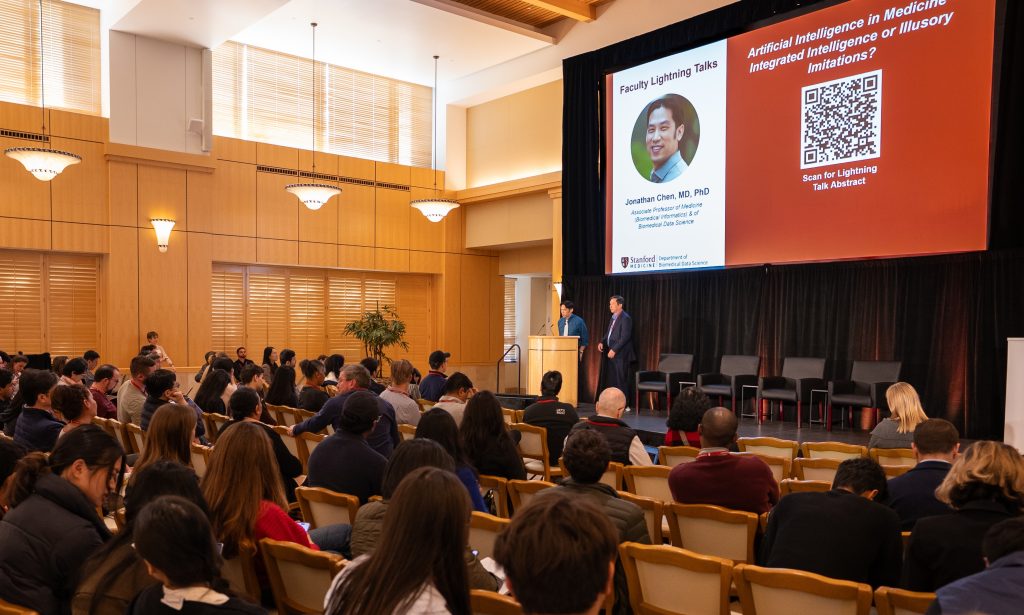
Developing systematic approaches to assess reliability, robustness, and long-term effectiveness remains one of the field’s most pressing challenges, as noted by Associate Professor Jonathan Chen, PhD, in his talk.
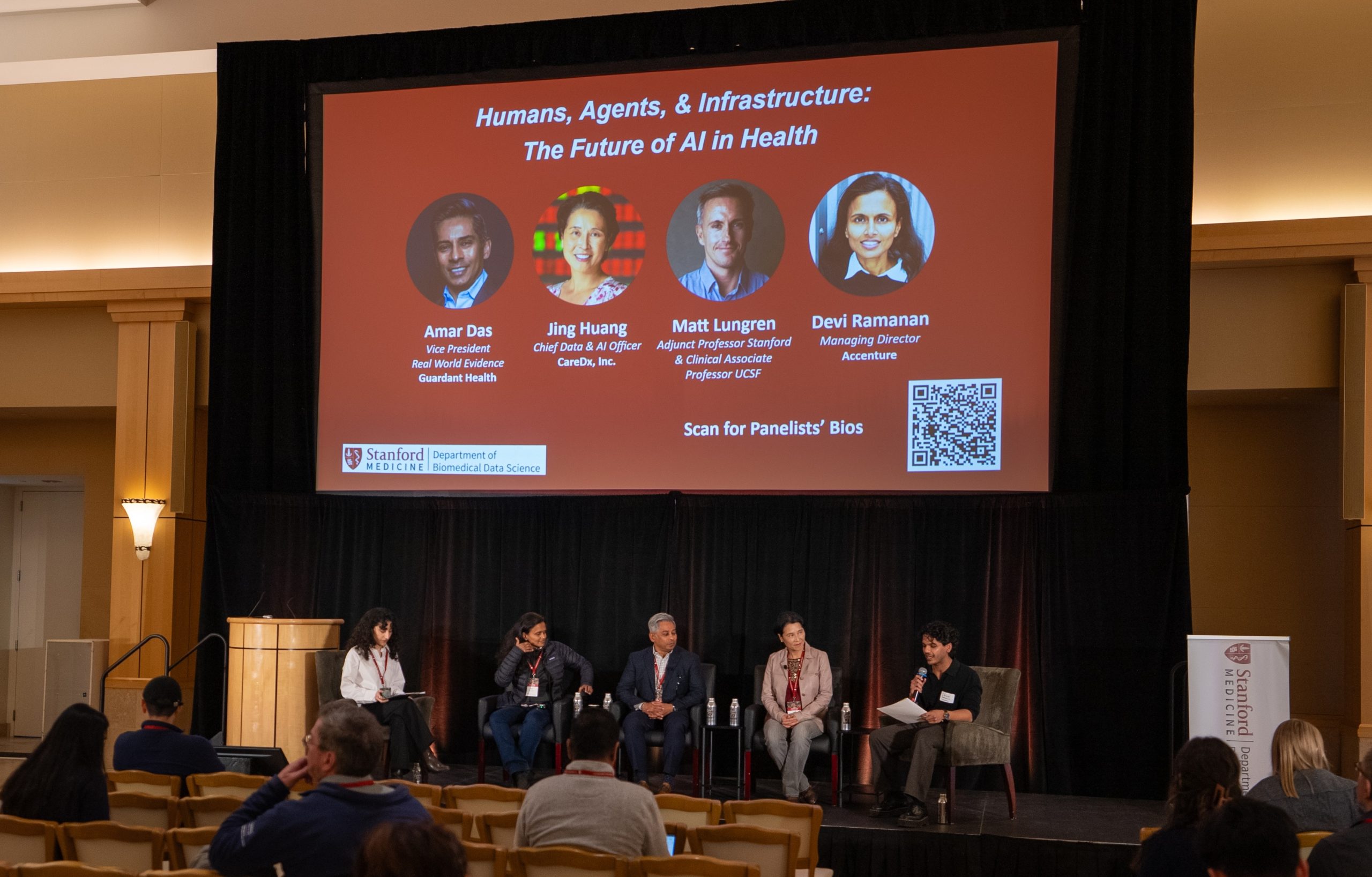
Echoing this notion, during the event’s afternoon industry panel, speakers stressed that successful implementation of AI in healthcare depends not only on sophisticated models, but on trust, transparency, and ongoing verification. The panel, “Humans, Agents, & Infrastructure: The Future of AI in Health,” was co-moderated by DBDS students Susie Avagyan (PhD candidate) and Shlok Natarajan (MS candidate). Panelists included Dr. Amar Das, Vice President, Real World Evidence, Guardant Health; Dr. Jing Huang, Chief Data & AI Officer, CareDx, Inc.; and Devi Ramanan, Managing Director, Accenture.
Acknowledging real-world challenges of achieving precision health, Assistant Professor Alex Ioannidis, PhD, spoke about how broad labels like “Hispanic” or “Mexican” do not accurately reflect people’s genetic backgrounds, which can muddy research results. Most people in Mexico have mixed ancestry from Indigenous American populations, Europeans, and Africans (to a smaller extent) —which is reflected by small but meaningful differences in their DNA.
His research illuminates how important it is for DNA information to be extremely precise—toward understanding how different ancestries affect both health and response to medications. In a similar vein, Professor Teri Klein, PhD, spoke about her work to personalize treatment with medications, recognizing that people’s responses to drugs are different based on genetics. Klein’s research has helped create tools that guide doctors on the safest and most effective medication doses. Some of these guidelines are now recognized by the U.S. Food and Drug Administration and included on official drug labels.
Connecting People and Ideas
As a two-way exchange of information, energy, and new directions, the C&C enables DBDS faculty and trainees to explore various ways to work together. Each participating organization hosts a dedicated table, creating space for discussions about research partnerships, data sharing, advising relationships, and long-term collaborations.
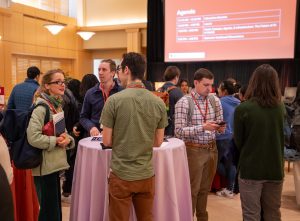
As with previous C&C events, DBDS trainees were active participants to prepare for their role as future leaders. Graduate students and postdocs moderated sessions, engaged directly with external partners, and showcased the depth of talent emerging from DBDS training programs.
For trainees navigating a rapidly evolving AI landscape, the C&C offered a chance to watch how AI is being deployed in biomedicine today and where it is headed next.
As attendance and engagement continue to grow, the C&C has become more than an annual event. It reflects DBDS’s expanding role within the tech- and health-heavy Bay Area region and the broader biomedical AI community both nationally and internationally. Convening diverse stakeholders around shared research challenges shows how DBDS’ persistent leadership will facilitate making AI research and deployment both scientifically rigorous and clinically meaningful.
For more information about C&C, including videos and photos from the event, visit the DBDS 2026 C&C website.