Category Archives: DBDS

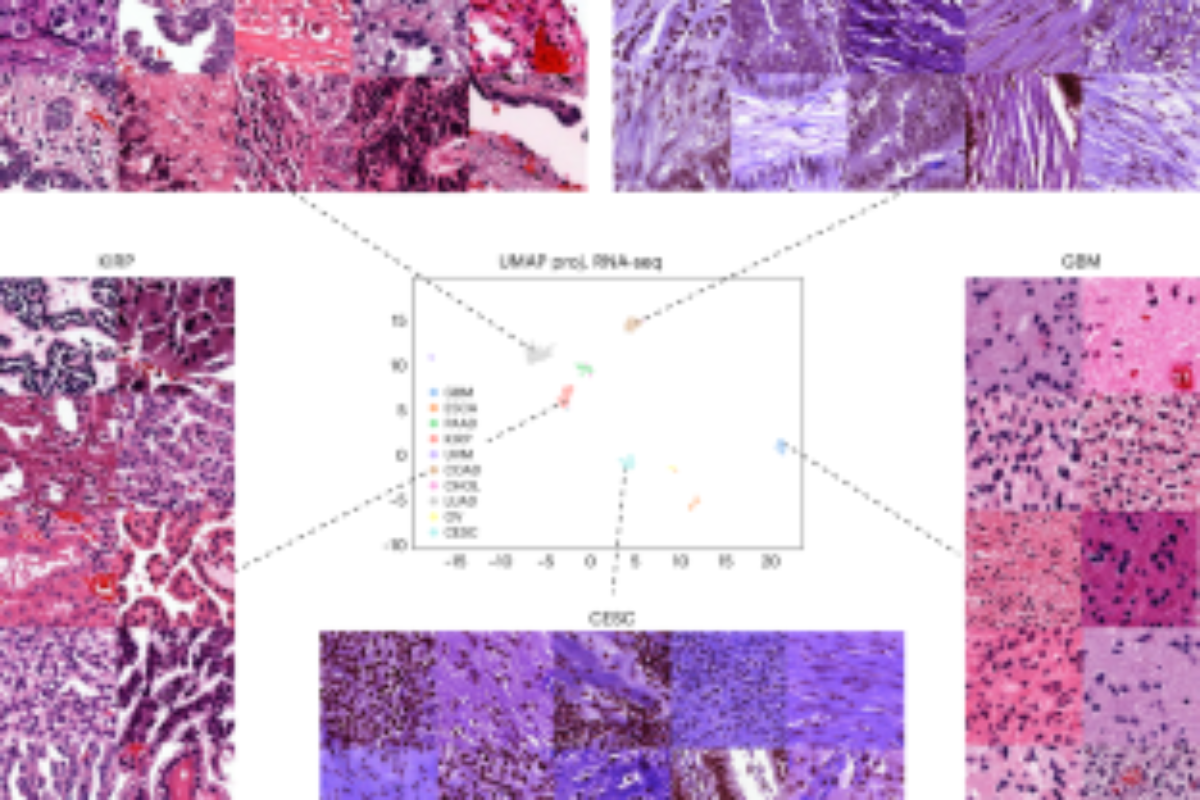
Olivier Gevaert and team have developed a biomedical model inspired by DALL-E, we use RNA expression profiles to generate synthetic digital pathology images across several cancer tissues. We show that these synthetic data can be used in combination with real data, cell type distributions are representative of real tissues and synthetic data can be used for self supervised learning. You can try the model here: https://lnkd.in/egWGGDYJ. We also generated 1M images for download: https://lnkd.in/eSsM9ZqA Amazing work by Francisco Carrillo Pérez in the lab, and only possible thanks to the Polaris compute resources and collaboration with Ravi Madduri at Argonne National Laboratory, U.S. Department of Energy (DOE). Full text is available here: https://rdcu.be/dBZJK. https://www.nature.com/articles/s41551-024-01193-8
Olivier Gevaert: “Generation of synthetic whole-slide image tiles of tumours from RNA-sequencing data via cascaded diffusion models” published in Nature Biomedical Engineering

Olivier Gevaert and team have developed a biomedical model inspired by DALL-E, we use RNA expression profiles to generate synthetic digital pathology images across several cancer tissues.
You can try the model here: https://lnkd.in/egWGGDYJ. We also generated 1M images for download: https://lnkd.in/eSsM9ZqA
Amazing work by Francisco Carrillo Pérez in the lab, and only possible thanks to the Polaris compute resources and collaboration with Ravi Madduri at Argonne National LaboratoryU.S. Department of Energy (DOE).
Full text is available here: https://rdcu.be/dBZJK.
https://www.nature.com/articles/s41551-024-01193-8

Understanding the genetic factors that underlie the normal variation in cardiac anatomy is of great interest. In this study, Rodrigo Bonazzola et al. applied unsupervised geometric deep learning to phenotype the left ventricle using an MRI-derived three-dimensional mesh representation (as depicted on the cover). We show that this approach boosts genetic discovery and provides deeper insights into the genetic underpinnings of cardiac morphology. Check out https://lnkd.in/edrvTg2W

Tanveer Syeda-Mahmood’s research featured in cover story for Nature Medicine Intelligence

Understanding the genetic factors that underlie the normal variation in cardiac anatomy is of great interest. In this study, Rodrigo Bonazzola et al. applied unsupervised geometric deep learning to phenotype the left ventricle using an MRI-derived three-dimensional mesh representation (as depicted on the cover). We show that this approach boosts genetic discovery and provides deeper insights into the genetic underpinnings of cardiac morphology.

Check out https://lnkd.in/edrvTg2W

The ClinGen Pharmacogenomics Working Group: Developing frameworks for evaluating pharmacogenomic gene validity and actionability Read it here: https://www.sciencedirect.com/science/article/pii/S294977442400222X Generating a framework for curating mechanism of disease in monogenic conditions: A consensus effort of the Gene Curation Coalition* Read it here: https://www.gimopen.org/article/S2949-7744(24)00622-8/fulltext

The ClinGen Pharmacogenomics Working Group: Exploring new directions and the evolution of PGx and genomic medicine

The ClinGen Pharmacogenomics Working Group: Developing frameworks for evaluating pharmacogenomic gene validity and actionability
Read it here: https://www.sciencedirect.com/science/article/pii/S294977442400222X

Generating a framework for curating mechanism of disease in monogenic conditions: A consensus effort of the Gene Curation Coalition*
Read it here: https://www.gimopen.org/article/S2949-7744(24)00622-8/fulltext